I am an Assistant Professor at the University of California Santa Cruz. In 2025-26, I will be the Philip Quinn Fellow at the National Humanities Center. I also lead the UCSC Aesthetics Reading Group. If you’re interested in joining, feel free to reach out via email.

I work on contemporary issues in value theory, in particular moral psychology and aesthetics, its intersection with philosophy of mind, as well as on the history of these fields. I am especially interested in how values influence perception and imagination, both in positive ways, such as through the development of aesthetic expertise, and in negative ways, for instance when our perceptual and imaginative processes are hijacked and distorted. My historical interests encompass 17th- and 18th-century philosophy, with a particular focus
on Immanuel Kant.
Books

Articles
“Bias Reduction as an Aesthetic Norm”
Philosophical Topics, 2025
Traditional aesthetic theories emphasize pleasure, while recent non-hedonistic approaches prioritize “getting it right” in aesthetic engagement. This paper critiques Dominic McIver Lopes’s and C. Thi Nguyen’s theories by arguing that correctness is neither the necessary guiding norm nor the constitutive or right motivator. Instead, I propose bias reduction—minimizing the improper influence of prior outlooks. This shift from correctness to minimizing distortion better captures aesthetic agency and allows for pluralism and radical disagreement.
“Bolzano’s Aesthetic Cognitivism”
Journal of the American Philosophical Association, 2025
This article examines Bolzano’s aesthetic cognitivism. It argues that, while reminiscent of German rationalist aesthetics and hence potentially appearing rigid and outdated, Bolzano’s version of cognitivism is, in fact, highly innovative and more flexible than the cognitivism championed by the rationalists. He imports from the rationalists the idea that aesthetic appreciation and creation are rule-governed, yet does not construe rule-following and engaging in free aesthetic activities as mutually exclusive. Furthermore, thanks to his nuanced treatment of the interaction between aesthetic values and other types of values, Bolzano’s aesthetic cognitivism presents a fresh alternative to contemporary versions of aesthetic cognitivism.
“Recovering Fictional Content and Emotional Engagements with Fiction”
Analysis, 2025
This paper critically engages with Peter Langland-Hassan’s Explaining Imagination, which defends a reductive account of imagination by analyzing activities such as pretense, daydreaming, and engagement with fiction in terms of basic folk psychological states. While I acknowledge the strengths of his case against the sui generis status of imagination, I challenge key aspects of his view on fictional engagement. Drawing on cases of imaginative resistance, I argue that inference rules govern only certain types of imagining and that Langland-Hassan’s account of emotional engagement with fiction is incomplete. I propose a distinction between panoramic and selective imagining to better explain the limits of inference-guided imagination, and I defend a pluralistic approach to understanding emotional responses to fiction.
“Hume and Kant on Imaginative Resistance”
European Journal of Philosophy, 2024
The topic of imaginative resistance attracted considerable philosophical attention in recent years. Yet, with a few exceptions, no historical investigation of the phenomenon has been carried out. This paper amends this gap in the literature by constructing a Humean and a Kantian explanation. The main contributions of this historical analysis to this debate are to make room for emotions in explanations of resistance reactions and to upset the polarization between rival accounts by suggesting that our possible responses to morally flawed works can vary. In some cases, we resist imagining counter-evaluative claims due to our unwillingness to do so, and in others, due to our inability.
“Apt Perception, Aesthetic Engagement, and Curatorial Practices”
with Octavian Ion, Estetika: The European Journal of Aesthetics, 2024
This paper applies the account developed by Susanna Siegel in The Rationality of Perception to aesthetic cases and explores the implications of such an account for aesthetic engagement as well as curatorial and exhibitionary practices. It argues that one’s prior outlook – expertise, beliefs, desires, fears, preferences, attitudes – can have both aesthetically good and bad influences on perceptual experiences, just as it can have both epistemically good and bad influences. Analysing these bad influences in cases of ‘hijacked’ aesthetic perception will reveal that, unless we recognize that our perception of high-level and low-level aesthetically relevant properties is norm-governed, we will be at a loss to explain what goes wrong in these cases. Just as perception can be rational or irrational, so too can it be apt or inapt.
“Imaginative Resistance”
The Stanford Encyclopedia of Philosophy, first published 2020; substantive revision 2024
The phenomenon of “imaginative resistance” refers to psychological difficulties otherwise competent imaginers experience when engaging in particular imaginative activities prompted by works of fiction. Usually, we seem to have no trouble engaging with time-travel or space-exploration stories, superhero movies, or talking non-human animal fables. At other times, we do not seem to be able to play along that easily; for instance, when we are presented with an alternative Macbeth where
the facts of [Duncan’s] murder remain as they are in fact presented in the play, but it is prescribed in this alternate fiction that this was unfortunate only for having interfered with Macbeth’s sleep. (Moran 1994: 95)
The imaginative resistance debate came about as an attempt to unpack what’s going on in these special, puzzling cases. It is no surprise that Tamar Szabó Gendler referred to the phenomenon as “the puzzle of imaginative resistance” (2000). Since the phenomenon seems to be relatively narrow, the driving force behind scholars’ interest in it has been the possibility of drawing insights from analyses of this relatively insulated phenomenon for broader, hard-to-pin-down issues, such as the ethics-aesthetics relation, the nature of fiction and imagination, the functional role of imagination, and how imagination relates to belief and other states. (See Gendler and Liao 2016: 412–15, for a detailed survey of various accounts that use imaginative resistance related insights for solving a range of different philosophical problems.) However, as with any new and rapidly growing area of research, there has been much disagreement and confusion among scholars as to the precise nature of the phenomenon. Indeed, scholars disagree on
- whether such a phenomenon exists;
- whether it is really puzzling;
- whether it is puzzling for various reasons, and if so, whether these reasons are reducible to others;
- whether we resist imagining only moral deviations or whether the phenomenon is broader than that;
- whether the resistance to engaging in the imaginative activity is a result of the subject’s inability to engage in the prompted activity or the subject’s unwillingness to do so; and
- whether imaginative resistance cases put constraints on our cognitive imagination or conative imagination, or whether they have nothing to do with imagination at all.
As Kendall Walton puts it, the only thing that has been uncontested is the word “of” in “the puzzle of imaginative resistance” (2006: 146).
This entry is an attempt to get clear on the central issues surrounding imaginative resistance and examines the proposed solutions to the puzzle(s).
“Self-Standing Beauty: Tracing Kant’s Views on Purpose-Based Beauty”
Southwest Philosophy Review, 2019
In “Beauty and Utility in Kant’s Aesthetics,” Robert Clewis examines Kant’s shifting use of the term selbstständig to shed new light on the relationship between beauty and utility. Clewis argues that although Kant applies the term to both dependent and free beauty in different periods, its meaning remains consistent. While I agree with this linguistic point, I challenge Clewis’s broader claim that Kant consistently held a “blocking-unificationist” view of beauty and utility. I argue instead that Kant’s position evolved: in his early work, he embraced a “containment” model of beauty as a form of perfection, but later abandoned this view in favor of a more nuanced separation of beauty from utility. This reinterpretation offers a more coherent account of Kant’s aesthetic development.
“Kant on Informed Pure Judgments of Taste”
Journal of Aesthetics and Art Criticism, 2018
Two dominant interpretations of Kant’s notion of adherent beauty, the conjunctive view and the incorporation view, provide an account of how to form informed aesthetic assessments concerning artworks. According to both accounts, judgments of perfection play a crucial role in making informed, although impure, judgments of taste. These accounts only examine aesthetic responses to objects that meet or fail to meet the expectations we have regarding what they ought to be. I demonstrate that Kant’s works of genius do not fall within either of these categories. The distinguishing features of these works, namely, originality and exemplarity, become unrecognizable on these interpretations because originality and exemplarity lie in the work’s ability to exceed one’s expectations concerning its form and content. They contribute to artistic beauty through alternative transformation methods distinct from that of abstraction, namely, concept expansion and repudiation. These additional accounts of transformation lead to a rather surprising outcome: works of genius turn out to be paradigm cases where one can and indeed ought to form informed pure judgments of taste.
“Why didn’t Kant Think Highly of Music?”
in Natur und Freiheit: Akten des XII. Internationalen Kant-Kongresses 2015, 2018
There are two main questions to be addressed when assessing Kant’s remarks on music: (1) How can we reconcile Kant’s apparently inconsistent commitment to both expressivism and formalism with respect to music appreciation? (2) Why did Kant not think very highly of music? My aim in this paper is to answer the second question. I argue that, depending on which of the different attitudes we take towards objects, we can make either singular judgments or combination judgments of different sorts. Music, unlike other art forms, lends itself more easily to combination judgments involving judgments of sense, and this constitutes one of the two reasons why I believe that Kant takes a derogatory stance with respect to music. The second and more important reason is grounded in the difference between music and other art forms: In music, I argue, aesthetic ideas are communicated by taking advantage of existing associations, while in those art forms that Kant held in high regard (such as poetry and painting) genius not only breaks with the laws of association but additionally creates new associations. This, I propose, is why, according to Kant, music is not as rich a source for reflection and thereby cannot stimulate the enlargement of the cognitive faculties. Given that the enlargement of the cognitive faculties is the very standard that Kant uses in setting up the hierarchy of fine arts, this explains why he placed music at the bottom of his hierarchy.
“A Kantian Hybrid Theory of Art Criticism: A Particularist Appeal to the Generalists”
Journal of Aesthetics and Art Criticism, 2016
Noël Carroll proposes a generalist theory of art criticism, which essentially involves evaluations of artworks on the basis of their success value, at the cost of rendering evaluations of reception value irrelevant to criticism. In this article, I argue for a hybrid account of art criticism, which incorporates Carroll’s objective model but puts Carroll‐type evaluations in the service of evaluations of reception value. I argue that this hybrid model is supported by Kant’s theory of taste. Hence, I not only present an alternative theory of metacriticism, which has the merit of reinstating the centrality of reception value in art critics’ evaluations, but also show that, contrary to a common conception, Kant’s aesthetic theory can house a fruitful account of art criticism. The benefit of this hybrid account is that, despite being essentially particularist, it should be appealing even to generalists, including Carroll.
“The Underridization of Nancy: Tracing the Transformations in Nancy’s Idea of Community”
Journal for Cultural Research, 2014
My aim in this paper is to expose a misrepresentation of Jean-Luc Nancy’s ideas on community in the secondary literature. I argue that discussions of Nancy’s work have failed to recognize a transformation that has occurred in his later thought, which distances him from Jacques Derrida. I propose that Nancy’s later work points the way beyond the “persistence of unhappy consciousness” in deconstruction through allowing for the possibility of the creation of a world alternative to globalization. Recognition of this transformation is suggestive for how Nancy’s theoretical framework might be employed in analyses of recent resistance movements.
Reviews
“Baumgarten’s Aesthetics: Historical and Philosophical Perspectives by J. Colin McQuillan (ed) (review),”
Journal of the History of Philosophy, 2023
“Thinking with Kant’s Critique of Judgment by Michel Chaouli (review)”
Journal of the History of Philosophy, 2018
“The Science of Culture and the Phenomenology of Styles by Renato Barilli (review)”
University of Toronto Quarterly, 2014
Teaching
In previous years I’ve had the opportunity to teach a variety of courses at MacEwan University and at the University of Alberta: Introductions to Philosophy (Values and Society; Knowledge and Reality), Bioethics, Aesthetics, and Existentialism. At UCSC, I have taught courses on the history of philosophy, aesthetics, moral psychology, philosophy of mind, feminist philosophy, and existentialism.

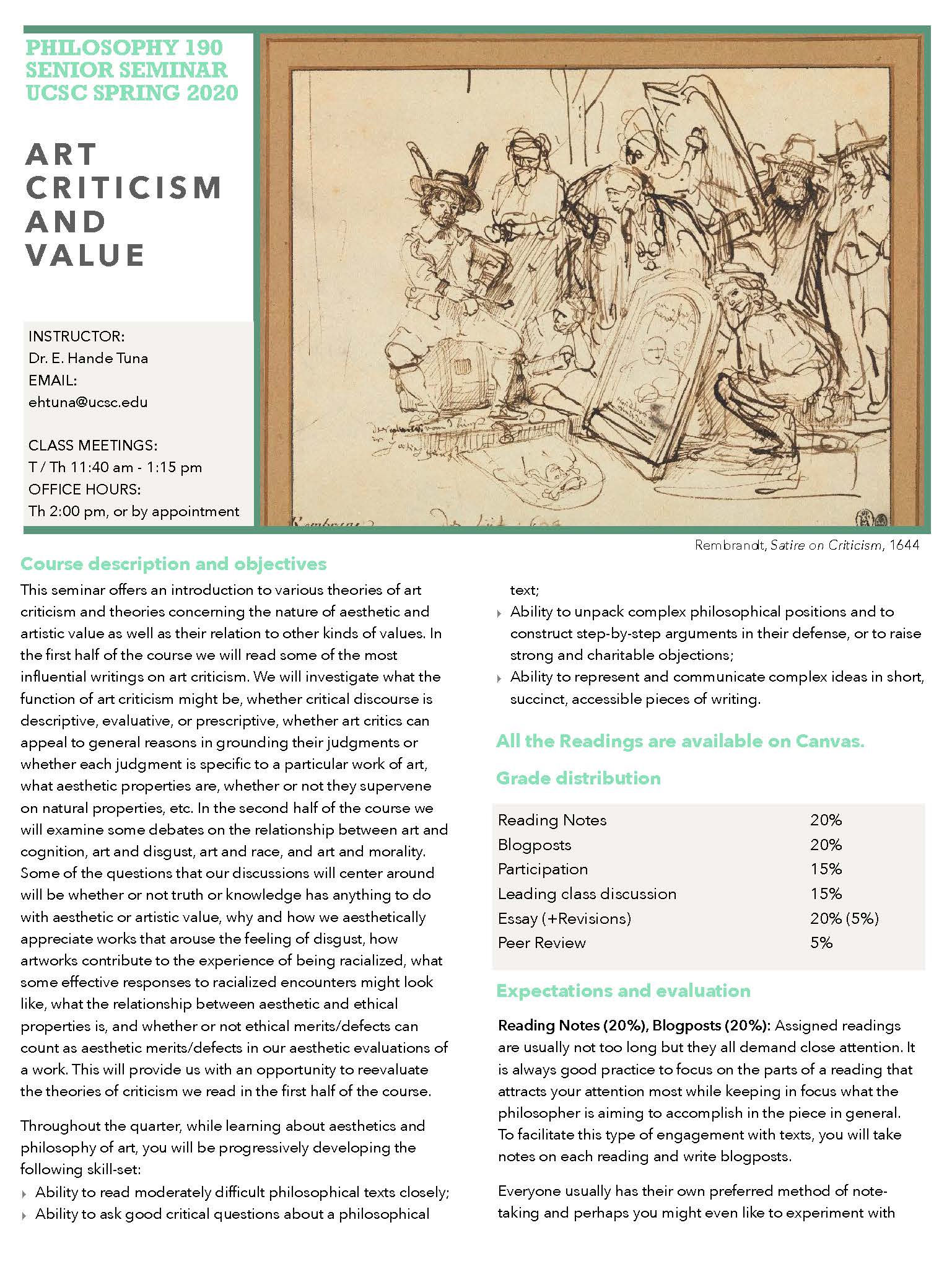
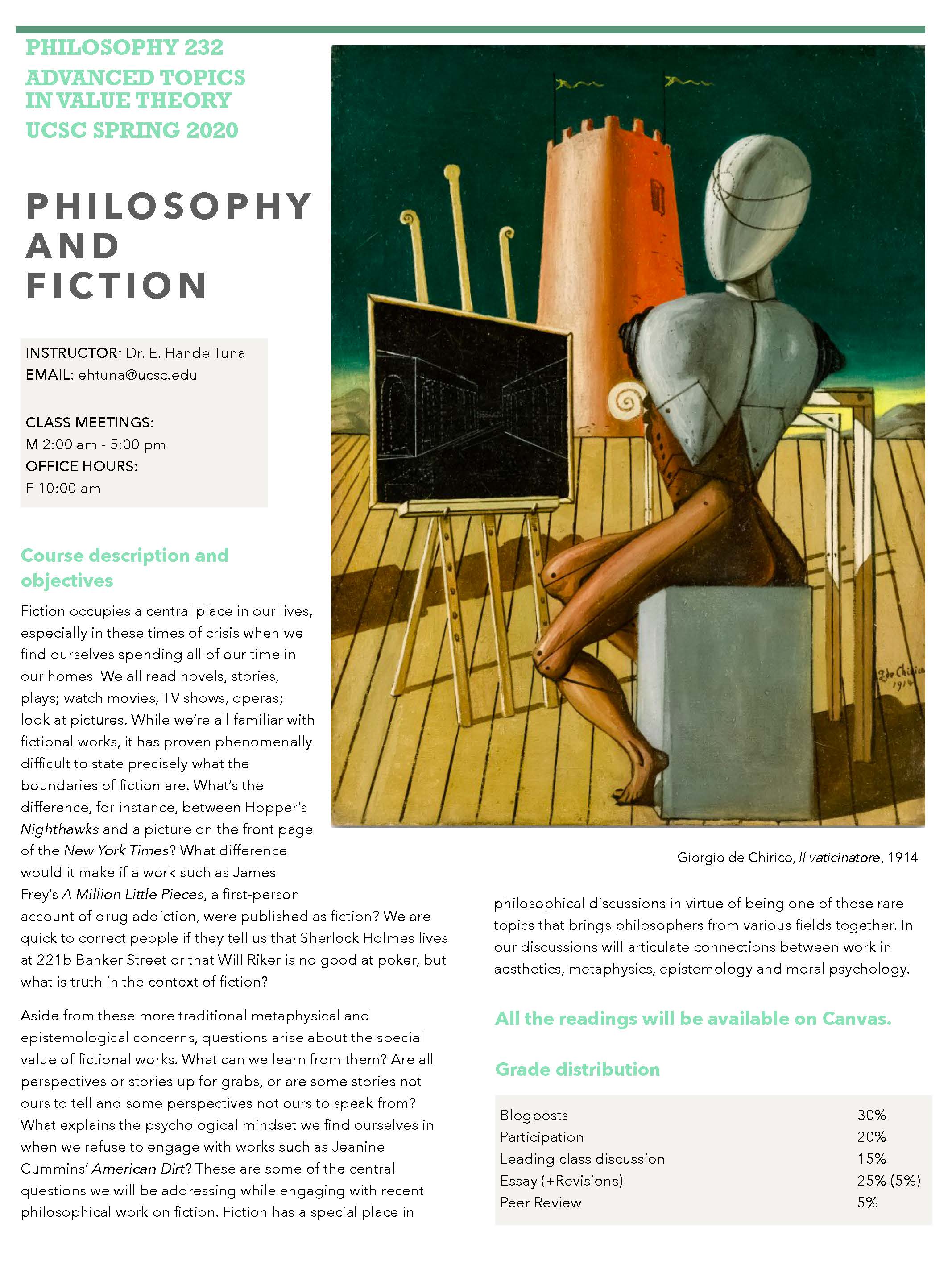

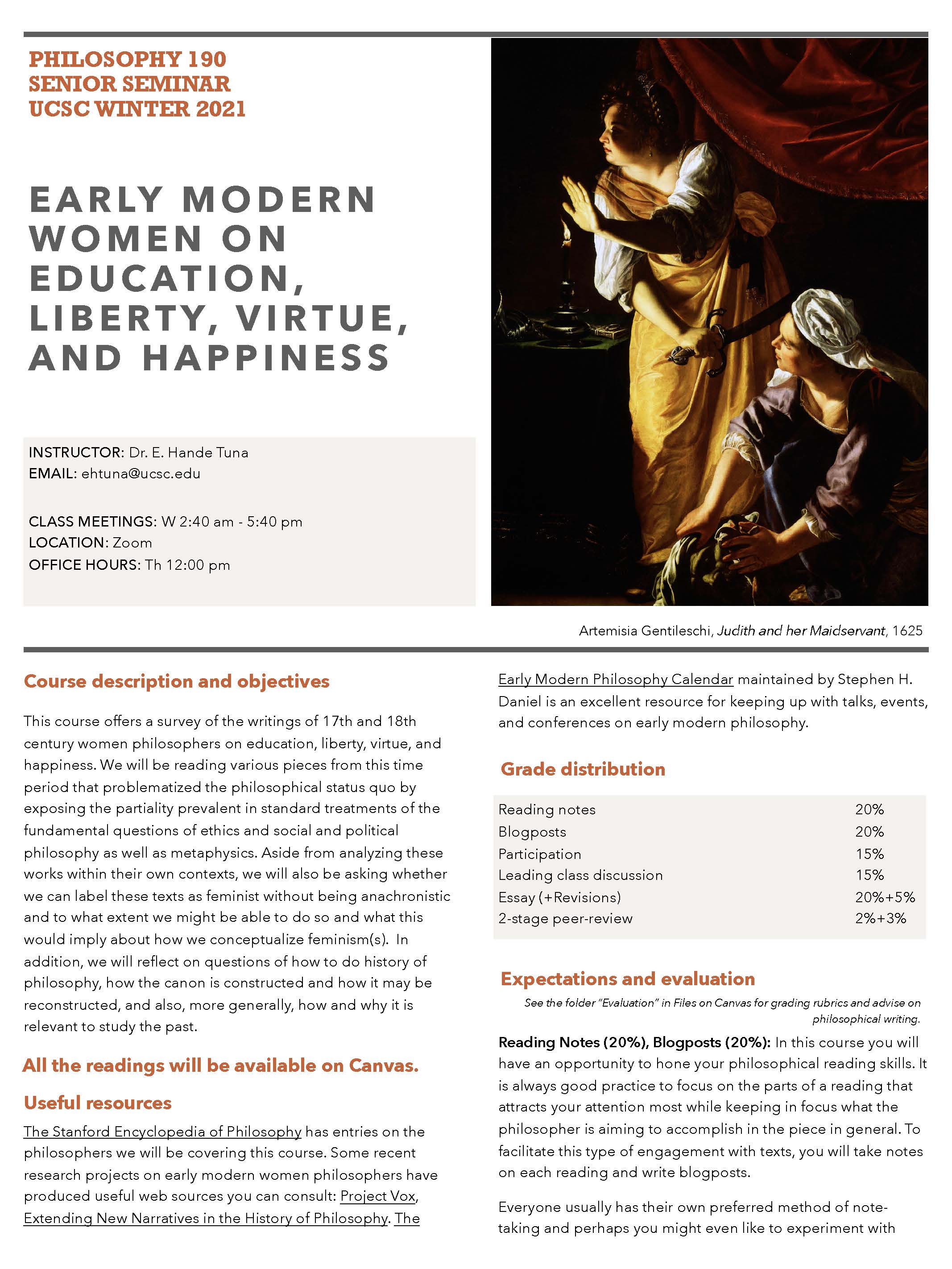
In the Spring Quarter of 2025, I am set to teach Introduction to Philosophy, as well as a graduate seminar on the philosophy of imagination. If you are interested in taking or auditing any of these classes, please do not hesitate to contact me. You can reach me via email.
 Emine Hande TUNA